





Thinking of starting a manufacturing business in Dubai? Great decision.
The city has positioned itself as a global hub for trade, logistics, and production, which makes it an attractive base for manufacturers targeting both regional and international markets.
Setting up your manufacturing business in Dubai requires careful planning, especially when it comes to choosing the right jurisdiction and licensing structure. This decision isn’t just about geography or convenience. The jurisdiction you select shapes how your business is owned, what kind of license you need, the taxes you’ll be subject to, and even how easily you can move goods across borders.
A well-chosen jurisdiction can lower operating costs, simplify compliance, and give direct access to the right markets. A poorly chosen one can limit growth opportunities and add unnecessary hurdles.
That’s why understanding the difference between mainland, free zones, and dedicated industrial areas is essential before making the leap into Dubai’s manufacturing sector.
Why Jurisdiction Matters for Your Manufacturing Business
You might be thinking, “Why does it really matter where I set up?” Well, here’s the deal.
Dubai isn’t one big uniform space when it comes to business setup. The rules, regulations, and benefits change depending on whether you’re in a free zone, on the mainland, or in an industrial area.
Your jurisdiction determines:
- Ownership rules: Can you own 100% of your company, or do you need a local partner?
- Taxes and fees: Some zones have tax benefits or exemptions, while others follow standard corporate regulations.
- Licensing flexibility: Not all licenses are available everywhere, especially for manufacturing activities.
- Proximity to suppliers and customers: Location can impact your logistics costs and delivery times.
If you don’t choose wisely, you could end up paying more, facing restrictions, or limiting your growth.
So, how do you actually make the right choice? Let’s break down your options.
Mainland vs Free Zone: The Classic Dubai Dilemma
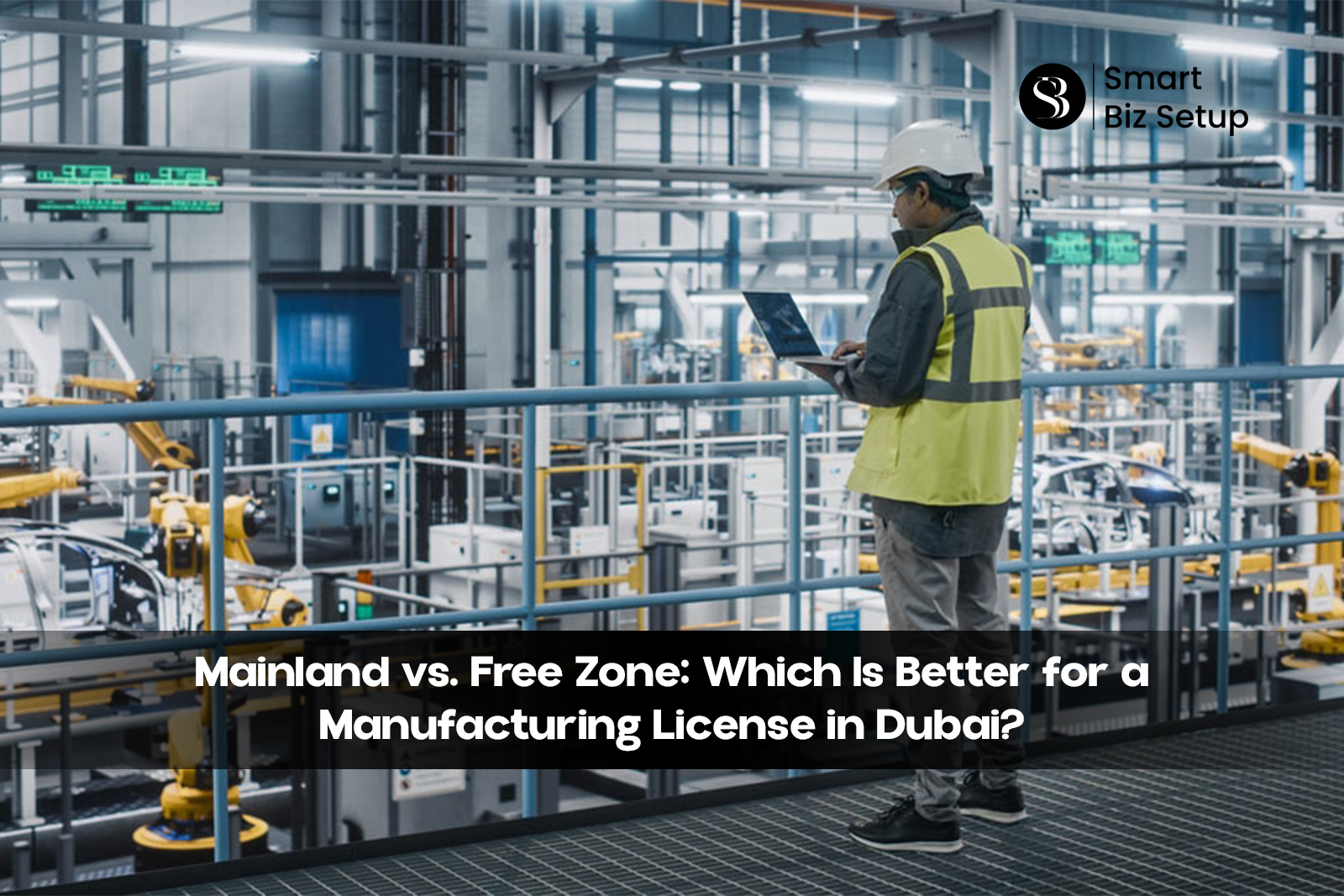
One of the biggest decisions for anyone setting up a manufacturing business in Dubai is choosing between the mainland and a free zone.
The choice is not just a legal formality—it directly affects how your company operates, how products reach customers, and how flexible your business can be in the long run.
Mainland Manufacturing in Dubai
Setting up on the mainland makes sense if the target market is primarily within the UAE. Mainland companies can:
- Sell directly to the local market without needing a distributor or agent.
- Bid on government contracts, which can be lucrative for large-scale manufacturing companies.
- Enjoy flexibility in choosing office locations, warehouses, and industrial plots across Dubai and the wider UAE.
Certain types of manufacturing activities—especially those linked to food production, construction materials, or other regulated industries—require a mainland license to operate. So, if compliance with government regulations or a wide market reach is a priority, the mainland is often the stronger option.
Traditionally, mainland businesses required a local sponsor holding 51% ownership. Recent reforms, however, have opened doors to 100% foreign ownership in many manufacturing sectors, giving investors far more control. That said, companies must still navigate licensing rules and regulatory procedures under the Department of Economic Development (DED).
Free Zone Manufacturing in Dubai
Free zones were designed to attract foreign investment by making business setup simple, cost-efficient, and globally competitive. For manufacturers that are export-oriented, free zones can be very appealing. Some of the advantages include:
- Full ownership: Investors retain 100% control of their company.
- Streamlined setup: Licenses, visas, and company registration are typically bundled into quick, straightforward packages.
- Access to modern facilities: Most free zones are equipped with advanced infrastructure, including industrial plots, ready warehouses, and logistics hubs.
However, there are limitations. A free zone company cannot sell directly to the UAE mainland market without appointing a local distributor or setting up a mainland branch. Also, free zones tend to be industry-specific. Not every manufacturing activity is permitted everywhere; for example, a zone designed for light industries may not allow heavy manufacturing operations.
Making the Choice
So, what’s the right move? It depends on business goals:
- If most products are meant for local UAE customers, the mainland offers greater freedom.
- If the focus is on exports and international trade, a free zone may provide more value, especially when combined with the benefits of tax exemptions and infrastructure.
In short, the question isn’t just “Where should I register my company?” but “Who am I selling to, and how do I want my business to grow?” That answer will shape whether the mainland or the free zone is the right jurisdiction for a manufacturing company in Dubai.
Industrial Zones: The Backbone of Manufacturing in Dubai
When it comes to manufacturing, industrial zones are where the real action happens.
Dubai has built several hubs designed specifically for factories, warehouses, and large-scale production facilities. These zones aren’t just about space—they’re about creating an ecosystem that makes manufacturing smoother and more cost-efficient.
Here’s what industrial zones typically offer:
- Large plots and custom-built facilities for factories, warehouses, and assembly units.
- Specialised infrastructure, including heavy-duty power supply, water, waste management, and logistics support.
- Easy access to transport links, including highways, ports, and airports, so raw materials can come in and finished products can go out without delays.
- Regulatory support that’s tailored to industrial activities, helping manufacturers stay compliant without unnecessary red tape.
Some of the most prominent industrial zones in Dubai include Dubai Industrial City, which caters to a wide range of light and heavy industries, and Jebel Ali Free Zone (JAFZA), known for its massive logistics network and direct port access. There’s also Dubai South, which is ideal for businesses that rely heavily on air cargo.
Why does this matter? Because the location of your factory isn’t just about where the building stands—it affects your supply chain, production costs, and delivery times. For example, a company exporting machinery overseas might benefit more from JAFZA’s port access, while a food processing plant may prefer Dubai Industrial City for its dedicated clusters and utilities.
So before finalising a jurisdiction, ask: Do you need to be close to ports for exporting? Are suppliers nearby? Is reliable infrastructure critical for your production? A well-chosen industrial zone can cut costs, reduce downtime, and make operations much more efficient.
How to Choose Your Manufacturing Jurisdiction in Dubai
Okay, now that we’ve covered the basics, here’s how to actually decide:
1. Define Your Business Goals
Ask yourself:
- Who are my target customers—local, regional, international?
- What scale am I planning for? Small batch or mass production?
- Will I need specialised infrastructure like warehouses, logistics support, or heavy machinery?
Your answers will guide whether a free zone, mainland, or industrial zone makes the most sense.
2. Check Licensing Requirements
Not all manufacturing activities are allowed everywhere. Each jurisdiction has its own rules about what type of manufacturing license you can apply for. Some zones focus on light industries like food, garments, or electronics, while others allow heavy industries like machinery or chemicals.
Pro tip: Always check the Dubai Manufacturing Free Zone vs Mainland rules for your specific industry. It can save you a ton of time later.
3. Ownership and Legal Requirements
Do you want complete control of your business, or are you okay with a local partner? Free zones usually allow 100% foreign ownership, while the mainland may require navigating local sponsorship.
Also, think about legal jurisdiction. This isn’t just paperwork—it affects dispute resolution, contracts, and compliance obligations. Choosing the right jurisdiction legally shields you from unexpected risks.
4. Costs and Incentives
Let’s be real, budgets matter. Mainland setup costs can include office leases, registration fees, and licensing charges. Free zones often provide bundled packages including office space, visas, and licenses. Some industrial zones also offer incentives for specific sectors.
You need to weigh these costs against potential benefits like market access, flexibility, and ease of expansion.
5. Infrastructure and Location
Does your factory need large plots, special utilities, or easy port access? Industrial zones are great here. Mainland areas near commercial hubs are better if you want easy access to local suppliers and clients.
Location also affects logistics costs. Consider how raw materials are received and finished goods are produced. Choosing the wrong area could result in spending more on transportation than necessary.
Free Zone vs Mainland: Quick Comparison
Here’s a quick comparison of the two main options for manufacturing businesses in Dubai:
| Feature | Free Zone | Mainland |
| Ownership | 100% foreign ownership | Recent reforms allow full foreign ownership in many sectors, but some require a local partner |
| Market Access | Mainly export-oriented; need a distributor for UAE sales | Directly sell to the UAE market and government contracts |
| Licensing Flexibility | Sector-specific | Broader license options |
| Cost | Package deals available | Costs vary; It can be higher due to office space and sponsorship fees |
| Legal Jurisdiction | Free zone authorities | Department of Economy and Tourism (DET) |
This table helps, but remember, every business is unique.
You may even consider a hybrid model depending on your goals.
Top Jurisdictions and Locations for Manufacturing in Dubai
By now, you know the big picture: you’ll either set up on the mainland or in a free zone.
Here’s a breakdown of the top manufacturing jurisdiction options in Dubai to help you decide the best fit for your business.
Mainland
On the mainland, your license is issued by the Department of Economy and Tourism (DET). Once that’s secured, you can set up in one of Dubai’s established industrial clusters:
- Al Quoz Industrial Area – Great for small to medium-scale factories that need to be close to the city for distribution.
- Ras Al Khor Industrial Area – Popular with light industries and businesses that need easy road connectivity across Dubai.
- Dubai Investments Park (DIP) – A master-planned community with factories, warehouses, and staff housing, making it a convenient choice for mid-to-large manufacturers.
- National Industries Park (NIP) – Suited for heavy and medium industries, with dedicated utilities and easy highway access.
These mainland zones are ideal if your manufacturing company depends heavily on UAE market access and you need flexibility in selling, sourcing, or distributing locally.
Free Zones
If your business is export-heavy or you want the benefit of 100% foreign ownership, free zones are worth considering. Each has its own focus and advantages:
- Jebel Ali Free Zone (JAFZA) – The largest and most established hub for manufacturers with global supply chains. Its direct connection to Jebel Ali Port makes it the top choice for export-oriented industries like machinery, chemicals, and automotive parts.
- Dubai Industrial City (DIC) – Purpose-built for manufacturing and logistics, with zones dedicated to food and beverage, machinery, base metals, and chemicals. Ideal for companies requiring extensive plots and long-term expansion space.
- Dubai South Free Zone – Strategically located next to Al Maktoum International Airport, it’s perfect for industries reliant on fast air cargo—like electronics, pharmaceuticals, and perishable goods.
- Dubai Silicon Oasis (DSO) – A technology-focused free zone, suitable for electronics manufacturing, light assembly, and high-value components.
Putting It Together
So, what’s the “best” jurisdiction for a manufacturing business in Dubai? There isn’t a one-size-fits-all answer.
- If your main customers are within the UAE, the mainland will likely serve you better.
- If your business is built on exports, a free zone like JAFZA or DIC could give you the infrastructure and global connectivity you need.
- And if your operations are niche (like tech or food processing), consider specialised zones such as DSO or dedicated food clusters in DIC.
The smart move is to weigh ownership flexibility, licensing rules, logistics needs, and cost structures against your growth plans. That way, your jurisdiction isn’t just a setup formality—it becomes a launchpad for scaling your manufacturing company in Dubai.
Common Mistakes When Choosing a Manufacturing Jurisdiction in Dubai
You’d be surprised how often new manufacturers pick the wrong jurisdiction and regret it later. It’s not always about the cost of setup—sometimes it’s about overlooking the basics that make or break your operations.
Here are a few pitfalls to avoid:
Picking a free zone without checking activity permissions
Not every free zone allows every type of manufacturing. For example, some zones are limited to light industries like packaging or electronics assembly, while others handle heavy industries such as chemicals or metals. Always confirm that your chosen free zone accepts your specific activity before applying for a manufacturing license in Dubai.
Ignoring local market requirements
If your goal is to sell directly to UAE customers, the mainland manufacturing jurisdiction in Dubai might be mandatory. Free zone companies can’t trade with the local market without going through a distributor, which cuts into profit margins. Many investors overlook this and only realise later that their setup limits growth.
Underestimating logistics and supply chain costs
A cheap industrial plot looks good on paper, but what about transport? If your factory is far from ports, airports, or suppliers, you’ll end up paying more in logistics. Choosing the right industrial zone in Dubai—close to either export hubs or local suppliers—can save huge costs in the long run.
Skipping legal advice
Regulations in Dubai evolve quickly, especially around legal jurisdiction for manufacturing and ownership structures. A setup that works today may have different requirements tomorrow. Consulting with experts before registering your manufacturing company in Dubai helps you stay compliant and avoid costly restructuring later.
Avoiding these mistakes not only saves money but also ensures your business setup aligns with your long-term manufacturing goals in Dubai.
To choose a jurisdiction for Dubai manufacturing effectively, consider your target market, production scale, and long-term growth goals.
Make the Right Choice with Smart Biz Setup
Choosing the right jurisdiction for your manufacturing business in Dubai isn’t just a formality—it’s a strategic decision that impacts ownership, licensing, growth, and long-term success. Ask yourself: Who are your customers? What type of manufacturing will you focus on? How much control do you want over your business? Where do you want your company to grow?
By carefully evaluating mainland vs free zone, considering industrial zones in Dubai, and understanding your manufacturing license options, you can select a jurisdiction that aligns perfectly with your business goals.
This is where Smart Biz Setup comes in. Our team helps you navigate Dubai’s complex manufacturing landscape, guiding you through jurisdiction selection, licensing requirements, and industrial zone options. We make sure your manufacturing company in Dubai is set up efficiently, fully compliant, and positioned for growth—so you can focus on running your business, not paperwork.
Contact Smart Biz Setup to explore your jurisdiction options, secure the right license, and set up your manufacturing business in Dubai with confidence.